
Just imagine you go to a website and it takes several seconds for the page to open. Then when you tap on any button nothing happens. What do you do in such a situation? Most people do what you would: close the page and go to another site.
To solve this problem, Google has created Core Web Vitals. In this blog we will understand in simple language what these are and how to make your website faster in 2026.
What are Core Web Vitals?
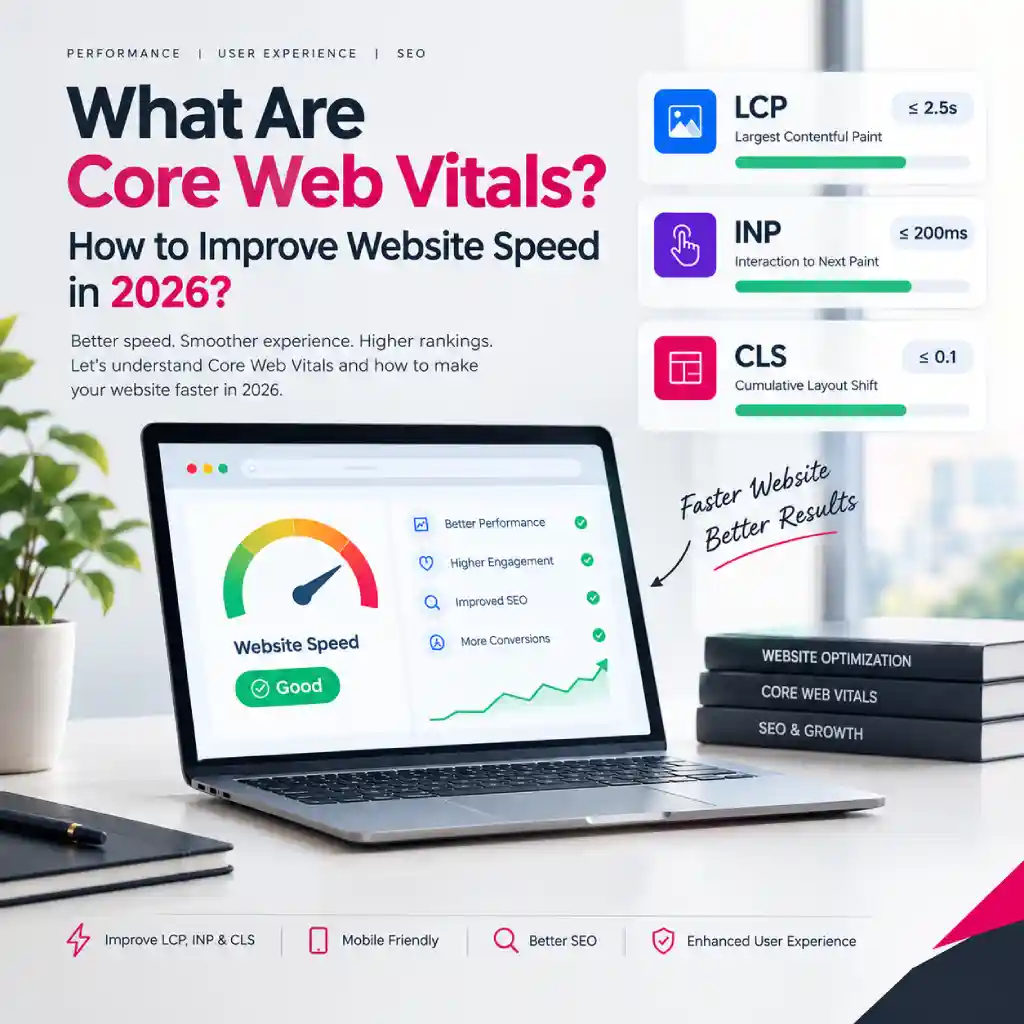
Core Web Vitals are three metrics from Google that tell us what kind of experience visitors are having on your website. These important Google Core Web Vitals metrics help measure website performance and page experience. They answer three questions:
-
How quickly does the main part of the page appear?
-
How quickly does the site respond to clicks or taps?
-
Does the content move here and there while loading?
With this data you can understand where the problem is and where to start fixing it through Core Web Vitals optimization.
Three main metrics
1. Largest Contentful Paint (LCP)
Largest Contentful Paint (LCP) measures how long it takes for the largest visible part of the screen such as the main image or a large text block, to load. According to Google it should be 2.5 seconds or less.
How to improve:
- Compress large images.
- Get good and fast hosting.
- Reduce server response time.
- Remove unnecessary code that slows down the page
2. Interaction to Next Paint (INP)
Interaction to Next Paint (INP) measures how quickly a site responds after a visitor clicks or taps. If the site gets stuck for a few moments after pressing the button the INP is bad. A good score is considered to be 200 milliseconds or less.
How to improve:
- Don't run too much JavaScript.
- Avoid heavy scripts.
- Keep buttons and forms light and fast.
- Remove any plugins that are not being used.
3. Cumulative Layout Shift (CLS)
Have you ever been about to tap a button and then an image loaded and the button moved down, causing you to click on the wrong thing? Cumulative Layout Shift (CLS) measures this unwanted drift. A good score is 0.1 or less.
How to improve:
- Decide the width and height of the image and video in advance.
- Leave space for ads and dynamic content in advance.
- Be careful that the text does not jump when the font is loaded.
How to check your website speed?
Before making improvements, one should know where the problem is. These free website speed testing tools can help you check website performance and identify Core Web Vitals issues.
Google PageSpeed Insights: Enter your site's URL and see its scores on both mobile and desktop. Along with this, suggestions for website speed optimization are also given.
Google Search Console: Its Core Web Vitals report shows pages that need work based on data from real users.
Chrome Lighthouse: This allows you to check performance, accessibility and other technical things. It is useful for running a website performance test and finding opportunities to improve page loading speed.
Easy ways to boost your speed 2026
Shrink image size: Large images are the biggest drag on page speed. Compress them before uploading and save in WebP or AVIF format if possible. Image optimization is an important part of website speed optimization and can help improve LCP.
Sort out plugins: In WordPress we often forget to add plugins. Remove things that aren't working. Unnecessary plugins can add scripts and other resources so reviewing them can help with WordPress website speed optimization.
Keep caching on: Caching helps make the page load faster. The result is that visitors have to wait less.
Keep your code clean: Remove unused CSS and JavaScript. Get the essentials loaded in the right order so the page opens without stuttering.
Be sure to test on mobile: Most of your visitors come from phones, so check loading times, buttons and forms there. Mobile website speed optimization is important for providing a smooth browsing experience across different devices.
Remember one thing, every website has a different problem. Therefore, after every change, test the site again.
Why Do Core Web Vitals Matter for SEO?
Visitors find a site easy to use when pages open quickly, buttons work well, and content stays in place. Google also counts Core Web Vitals as one of the indicators of page experience.
But also understand that a good score alone does not guarantee top ranking. Useful content, technical health of the site and other SEO factors are equally important.
Conclusion
It is now important to understand Core Web Vitals to build a fast and reliable website in 2026. LCP, INP and CLS can help you identify the real vulnerabilities of your site. Keep checking regularly with PageSpeed Insights and Search Console and make small improvements, and results will start appearing.
If you want to know more about website design and development, then you can connect with Udaipur Web Designer. A fast, mobile-friendly and well-optimized website gives your visitors a better experience.